A clear look at every listed ingredient, the research behind it, and the information the label leaves undisclosed.
By Dr. Marcus Reed, MD · Last Updated: July 23, 2026
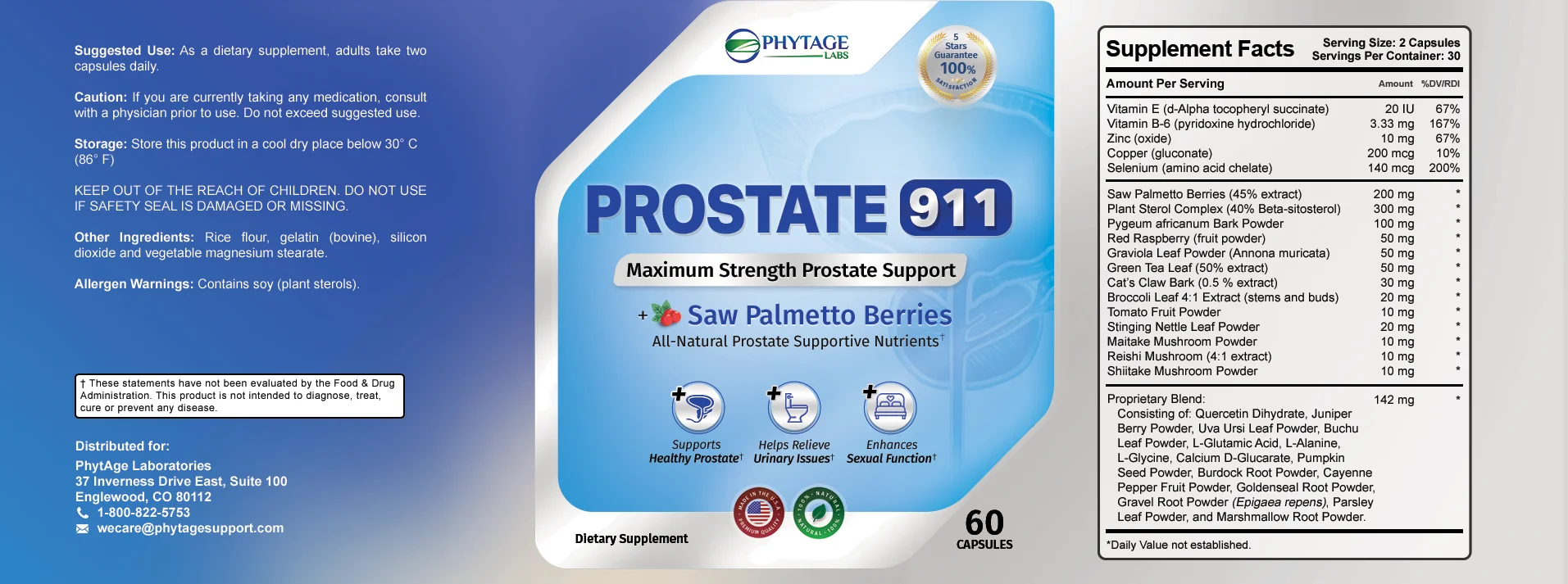
What the label shows: Prostate 911 contains saw palmetto, beta-sitosterol/plant sterols, pygeum africanum, stinging nettle leaf, pumpkin seed, cat's claw, broccoli leaf extract, tomato powder (lycopene), maitake/reishi/shiitake mushrooms, green tea, graviola, red raspberry, zinc, copper, selenium, vitamin E, vitamin B6, and a 142 mg proprietary blend of thirteen further ingredients. Five of these have randomized-trial evidence for BPH symptoms; the remaining ingredients play supporting roles.
The lead botanical in most prostate formulas, including this one. Saw palmetto (Serenoa repens) is studied for helping inhibit 5-alpha-reductase, the enzyme that converts testosterone into DHT — the hormone that signals prostate tissue to grow. A randomized placebo-controlled trial of a saw palmetto and beta-sitosterol combination reported significantly reduced nocturia and daytime frequency (PMID 12092634).
Arguably the ingredient with the most consistent randomized-trial evidence for BPH urinary symptoms. Beta-sitosterol inhibits 5-alpha-reductase in the same direction as prescription 5-ARI drugs, though far more weakly, and improves symptom scores and urine flow at 60-130 mg daily (PMID 38148931).
One of the more distinctive inclusions here. A six-month randomized, double-blind, placebo-controlled crossover trial in 620 men found Urtica dioica improved IPSS scores and urine flow versus placebo (PMID 16635963). Laboratory work suggests nettle root components act on prostate Na+/K+-ATPase activity (PMID 7510891). Note the label specifies leaf powder, while most positive trials used root extract.
Bark extract from the African plum tree, prescribed as a registered medicine in France and Italy. A meta-analysis of 18 randomized trials found men more than twice as likely to report symptom improvement, with nocturia reduced by roughly 19% and peak urine flow increased by 23% (PMID 11099686).
Cucurbita pepo seed supplies phytosterols, zinc, and essential fatty acids. The one-year randomized placebo-controlled GRANU study found pumpkin seed improved lower urinary tract symptoms in men with BPH (PMID 25196580), making it one of the better-supported secondary ingredients in the formula.
A South American vine (Uncaria tomentosa) containing alkaloids studied for anti-inflammatory and immune-supporting activity. Included to help the body maintain a healthy inflammatory response in prostate tissue rather than for any direct urinary effect.
A cruciferous extract supplying sulforaphane-family compounds valued for antioxidant activity and support of the body's own detoxification enzymes. Evidence here is mechanistic and dietary rather than from BPH symptom trials.
A natural source of lycopene, the carotenoid most studied in prostate research. Higher lycopene intake has been associated with reduced prostate cancer risk in systematic review and meta-analysis (PMID 26287411), though this concerns long-term risk rather than immediate symptom relief.
Part of the Japanese mushroom trio. Maitake is an adaptogenic mushroom supplying beta-glucans, included for immune and antioxidant support alongside the prostate-specific botanicals.
Ganoderma lucidum, valued for antioxidant and immune-modulating triterpenes. It has been examined for effects on 5-alpha-reductase activity and lower urinary tract symptoms, though the human evidence is preliminary.
The third of the mushroom trio, contributing further beta-glucans and antioxidants for general immune and cellular wellness support.
Supplies catechins, principally EGCG, among the better-studied dietary polyphenols. Included as antioxidant support; research in men at elevated prostate risk has been cautiously encouraging but is not symptom-focused.
Two antioxidant-dense fruit and leaf extracts rounding out the botanical layer. Both are included for general antioxidant contribution; neither has direct randomized evidence for BPH urinary symptoms.
Zinc is concentrated more heavily in prostate tissue than in any other soft tissue, and adequate intake supports normal prostate function; dietary zinc appears in reviews as a protective factor for BPH (PMID 31577095). Copper is paired to prevent the depletion that sustained zinc intake can cause, and selenium contributes antioxidant selenoprotein activity.
Vitamin E provides fat-soluble antioxidant protection and appeared in the natural-product combination trial cited above. Vitamin B6 supports hormone metabolism and normal nervous-system function.
A single 142 mg blend containing quercetin dihydrate, juniper berry, uva ursi, buchu leaf, calcium D-glucarate, L-glutamic acid, L-alanine, L-glycine, burdock root, cayenne pepper, parsley leaf, marshmallow root and gravel root. Several have traditional urinary-tract uses. The honest limitation: because it is a proprietary blend, the individual amounts are not disclosed, so 142 mg spread across thirteen ingredients means each is present in a small quantity.
Prostate 911's ingredient selection is better than most competitors. Its ingredient disclosure is not, and both points can be true.
Five ingredients here carry credible randomized-trial evidence for BPH urinary symptoms: beta-sitosterol, saw palmetto, pygeum, stinging nettle and pumpkin seed. Most prostate products on the shelf contain one or two of those. Including all five, across complementary mechanisms, is a coherent design decision rather than label-stuffing.
Thirteen ingredients sit inside a single 142 mg proprietary blend. That is legal and common, but it means you cannot verify how much quercetin, juniper, uva ursi or pumpkin seed you are actually taking. Spread 142 mg across thirteen items and the arithmetic is unforgiving — the average is around 11 mg each, far below what most of them have been studied at.
Several disclosed doses are also modest. Cat's claw at 30 mg, broccoli at 20 mg, nettle leaf at 20 mg, tomato powder at 10 mg and each mushroom at 10 mg are all below the amounts typically used in research. The lead botanicals appear to be dosed more seriously, which is the right priority, but the supporting ingredients are present in small quantities.
The label specifies stinging nettle leaf powder. Almost all the positive BPH research on Urtica dioica — including the 620-man crossover trial and the German multicentre studies — used nettle root extract. Root and leaf have different phytochemistry; the root contains the lignans and sterols associated with prostate effects. This is a genuine gap between the citation and the ingredient, and it is the kind of detail most review sites do not check.
You will encounter claims that Prostate 911's ingredients are "FDA-approved" and that the formula delivers a "353% improvement". Neither statement survives scrutiny. No dietary supplement ingredient is FDA-approved — the FDA does not approve supplements, and GMP certification is a manufacturing standard, not an efficacy approval. The 353% figure has no traceable published source relating to this product.
None of that makes Prostate 911 a bad product. It makes the marketing unreliable, which is a different thing. Judge it on the supplement facts panel above: a broad, sensibly-chosen ingredient list with incomplete dose disclosure, from a GMP-certified U.S. facility, backed by a 90-day guarantee. That is a reasonable proposition on its own terms without any of the hype.
Saw palmetto, beta-sitosterol, pygeum, nettle and pumpkin seed in one daily formula. 90-day money-back guarantee.
Order from Official Website